
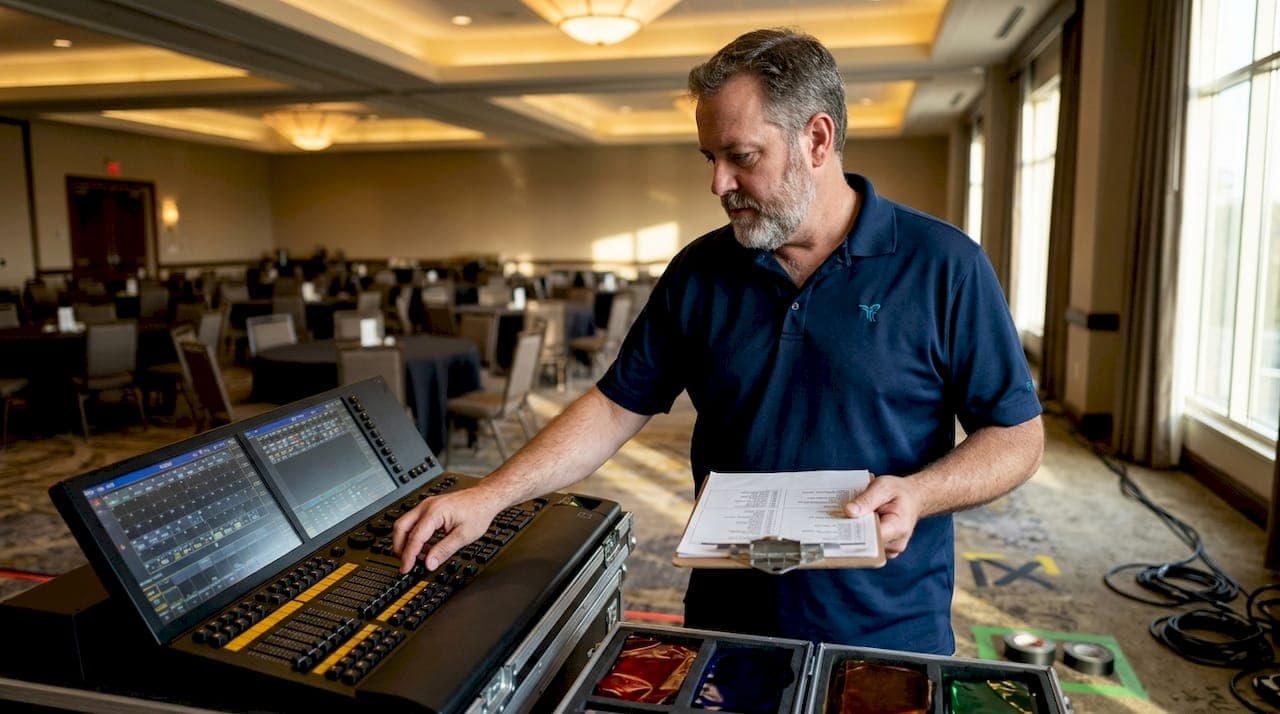
Hotel events can fall flat when stage lighting misses the mark. Guests squint under harsh spotlights, speakers disappear into shadows, and photos come out washed out or unflattering. These problems stem from poor planning and execution, not lack of equipment. This guide walks you through the complete process to plan, execute, and verify stage lighting in hotel venues. You'll learn which lighting types to use, how to set proper brightness levels, and how to test your setup so every event looks stunning both live and on camera.
Table of Contents
- Key Takeaways
- Understanding lighting types and planning requirements
- Setting lux benchmarks and zoning for effective illumination
- Executing the lighting setup: control, energy efficiency, and testing
- Verifying and troubleshooting stage lighting for flawless events
- Enhance your hotel events with expert lighting solutions
- FAQ
Key Takeaways
| Point | Details |
|---|---|
| Lighting types and planning | Identify the major lighting types and create a lighting plot that maps each fixture type to specific zones in the venue. |
| Lux benchmarks and zoning | Use zone specific lux targets such as stage 800 to 1200 lux, audience 200 to 300 lux, walkways 50 to 100 lux, and dining 200 to 300 lux to balance visibility and ambience. |
| Involve designers early | Plan and zone lighting early with designers, considering ceiling height, room dimensions, and event activities to prevent last minute issues. |
| LED and DMX control | Leverage LED technology and control systems like DMX or sACN for efficiency, color versatility, and precise cueing. |
| Test with performers | Test lighting with people onstage to ensure flattering, photogenic effects for live events and on camera. |
Understanding lighting types and planning requirements
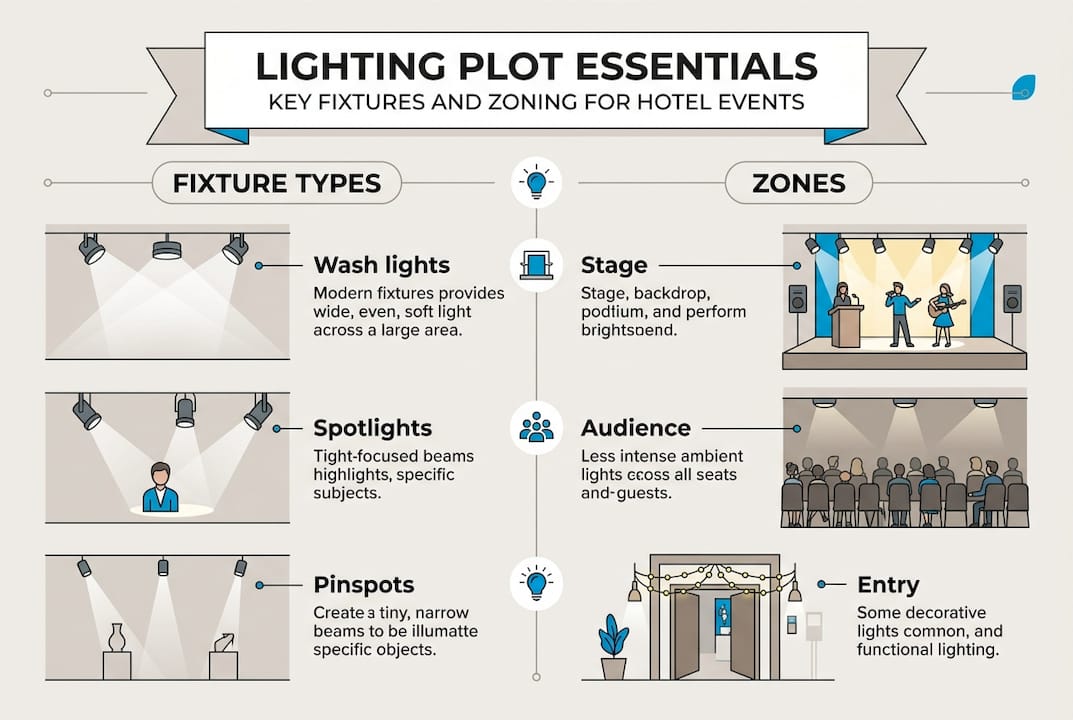
Stage lighting in hotels involves several distinct types, each serving a specific function. Wash lights flood broad areas with even illumination, creating the overall ambience for your event space. Spotlights direct focused beams onto speakers, performers, or centerpieces, drawing attention exactly where you want it. Uplighting transforms plain walls and columns into architectural features by casting light upward, adding depth and color to your venue. Downlighting provides general visibility from overhead positions, ensuring guests can navigate safely. Gobos project patterns or logos onto surfaces, adding visual interest and branding opportunities. Pinspots are narrow beams that highlight centerpieces, cakes, or decorative elements with precision.
Key lighting types include wash lights, spotlights, uplights, downlighting, gobos, and pinspots for comprehensive coverage. Each type requires careful placement and intensity control to work together effectively. Planning must account for ceiling height, room dimensions, and the specific activities happening in each zone. A wedding reception needs different lighting than a corporate presentation, even in the same ballroom.
| Lighting type | Typical fixtures | Ideal locations | Primary purpose |
|---|---|---|---|
| Wash lights | LED pars, fresnels | Front and side positions | Create even ambience across broad areas |
| Spotlights | Profile fixtures, followspots | Front of house, balcony | Highlight speakers and key moments |
| Uplights | LED cans, linear bars | Floor along walls | Enhance architecture and add color |
| Downlighting | Ellipsoidals, LED panels | Overhead grid | Provide general visibility |
| Gobos | Profile fixtures with patterns | Overhead or side angles | Project logos and decorative patterns |
| Pinspots | Narrow beam fixtures | Overhead positions | Accent centerpieces and details |
Successful lighting design for live audience and camera requires understanding how each type interacts with your venue's architecture. Consider power availability, rigging points, and sightlines during your initial walkthrough. Involve your technical team early to identify potential challenges before load-in day.
Pro Tip: Create a lighting plot that maps each fixture type to specific zones in your venue. This visual reference helps your team execute the design efficiently and ensures nothing gets overlooked during setup.
Setting lux benchmarks and zoning for effective illumination
Brightness matters more than most planners realize. Too much light washes out colors and creates harsh shadows that ruin photos. Too little leaves guests struggling to see menus or navigate safely. The solution lies in using specific lux measurements for each zone in your hotel venue.
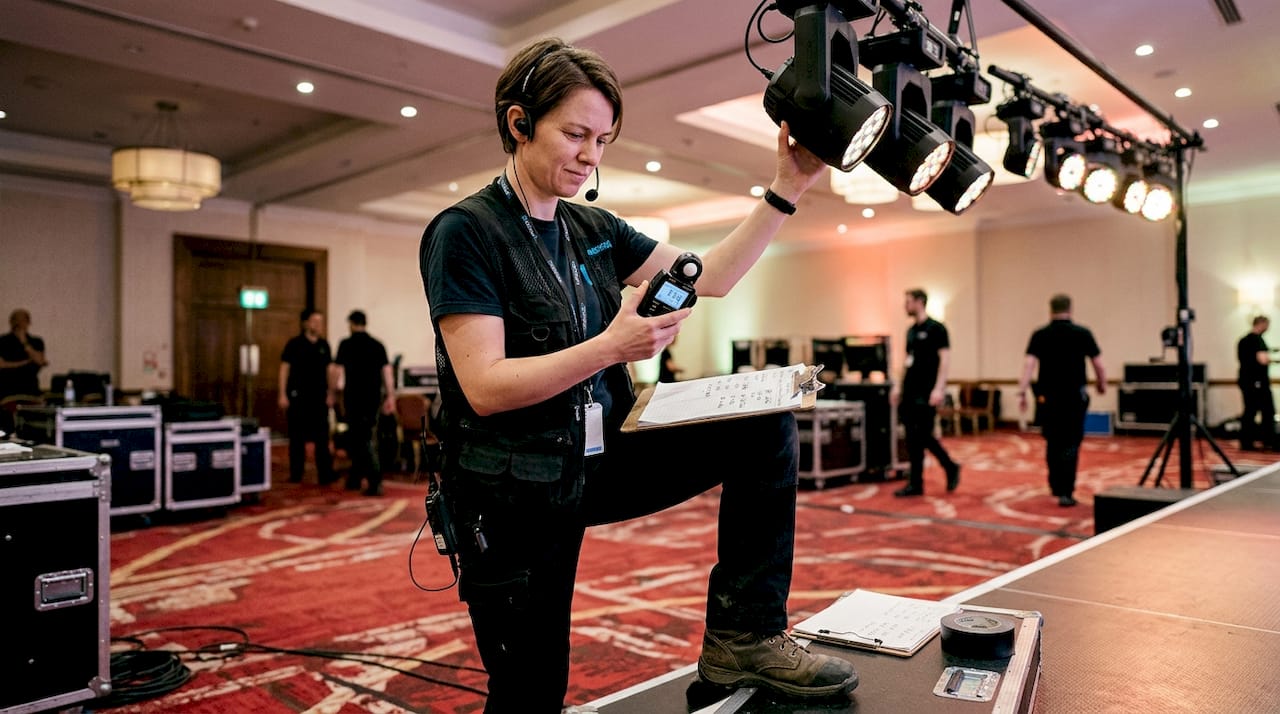
Recommended lux benchmarks: stage key light 800-1200 lux, audience 200-300 lux, walkways 50-100 lux, dining 200-300 lux provide the foundation for proper illumination. These ranges balance visibility with ambience, preventing the flat, overlit look that plagues many hotel events. Broadcast and hybrid events need higher levels, typically 1200-1500 lux on stage, to compensate for camera exposure requirements.
Zoning divides your venue into distinct areas with tailored lighting approaches. Entry zones need moderate brightness (150-200 lux) to welcome guests without overwhelming them as they transition from outdoor lighting. Dining areas require warm, even illumination (200-300 lux) that lets guests see their food and companions comfortably. Stage zones demand the highest levels (800-1200 lux) to ensure speakers and performers remain clearly visible. Dance areas benefit from dynamic, lower levels (100-200 lux) that create energy without blinding participants.
| Event zone | Live event lux range | Broadcast event lux range | Lighting priority |
|---|---|---|---|
| Stage key light | 800-1200 lux | 1200-1500 lux | Visibility and skin tone flattery |
| Audience seating | 200-300 lux | 300-400 lux | Comfortable viewing without glare |
| Dining tables | 200-300 lux | 300-400 lux | Warm ambience for conversation |
| Entry and registration | 150-200 lux | 200-250 lux | Welcoming transition space |
| Dance floor | 100-200 lux | 150-250 lux | Dynamic energy with safety |
| Walkways and exits | 50-100 lux | 100-150 lux | Safe navigation |
Adjusting these benchmarks requires understanding your specific event needs. Corporate presentations often need brighter stage lighting than weddings. Gala dinners work best with lower ambience lighting during meals, then brighter levels for speeches. Hybrid events streaming to remote audiences always need higher lux levels because cameras require more light than human eyes to produce quality video.
Effective lighting design for live audience and camera balances these competing demands through careful zoning and dimmer control. Modern LED systems let you adjust levels in real time, responding to changing program elements throughout your event.
Pro Tip: Bring a light meter to your venue walkthrough and measure existing ambient light levels. This baseline helps you calculate how much additional lighting you need to reach target lux levels in each zone.
Executing the lighting setup: control, energy efficiency, and testing
Proper execution transforms your lighting plan into reality. Follow these steps to ensure your hotel stage lighting delivers the results you planned.
- Install and position fixtures according to your lighting plot, verifying rigging points can support the weight safely.
- Run power and data cables using proper cable management to prevent trip hazards and signal interference.
- Configure your control system (DMX or sACN protocol) and program lighting cues for different event segments.
- Set baseline intensity levels for each zone using your lux measurements as targets.
- Program color temperatures and hues that complement your event theme and venue decor.
- Create backup cues and document your programming for quick troubleshooting during the event.
- Conduct a full system test with all fixtures running to identify any technical issues before guests arrive.
Involve designers early; use DMX/sACN control; LEDs save up to 80% energy versus traditional lighting and weigh significantly less than conventional fixtures. This energy efficiency matters in hotels where power circuits may be limited. A single 20-amp circuit can support many more LED fixtures than tungsten equivalents, reducing the need for expensive power distribution upgrades.
Control systems provide the backbone for professional stage lighting. DMX512 remains the industry standard protocol, transmitting 512 channels of control data per universe. Larger hotel installations often use sACN (streaming ACN) for network-based control that scales more easily across multiple universes. These systems let you adjust intensity, color, position, and effects from a central console, creating dynamic lighting that responds to your event's flow.
Common mistakes that compromise hotel stage lighting include:
- Setting all zones to the same brightness level instead of tailoring each area
- Ignoring color temperature differences between LED and ambient hotel lighting
- Skipping onsite tests with actual people onstage to verify skin tone appearance
- Overlooking backup plans for fixture failures or control system glitches
- Failing to coordinate with hotel staff about power requirements and load restrictions
- Using only overhead lighting without adding fill light to reduce harsh shadows
Professional lighting design for live audience and camera requires attention to these details during execution. The best lighting plans fail when implementation cuts corners or rushes through critical testing phases.
LED lighting technology delivers up to 80% energy savings compared to traditional tungsten fixtures while providing superior color control and longer operational life. This efficiency reduces both operating costs and environmental impact for hotel events.
Pro Tip: Schedule your lighting setup at least four hours before guests arrive. This buffer gives you time to test, adjust, and troubleshoot without the pressure of an imminent event start. Early setup also lets you see how your lighting interacts with natural daylight if your venue has windows.
Verifying and troubleshooting stage lighting for flawless events
Verification ensures your lighting delivers the quality your event demands. Use this checklist before guests arrive:
- Measure lux levels in each zone with a light meter to confirm they match your targets
- Check that all fixtures respond correctly to console commands and dim smoothly
- Verify color temperatures create a cohesive look across different fixture types
- Test gobo projections for focus and positioning accuracy
- Confirm uplighting enhances architectural features without creating distracting hotspots
- Review all programmed cues to ensure smooth transitions between event segments
- Document fixture positions and settings for future events in the same venue
Testing with actual people onstage reveals problems that empty stages hide. Skin tones appear different under various lighting conditions, and what looks good on fixtures alone may create unflattering shadows or color casts on faces. Position volunteers or staff members where speakers and performers will stand, then adjust your key and fill lights until skin appears natural and healthy.
Brighter is not always better; balance ambience with visibility to prevent discomfort and maintain visual depth. Overlighting flattens scenes and eliminates the dimensional quality that makes events feel dynamic and engaging.
When problems arise, follow these troubleshooting steps:
- Identify the specific issue: glare, uneven coverage, color inconsistency, or insufficient brightness.
- Isolate the problem fixtures by turning off sections of your lighting rig systematically.
- Check physical connections, power supply, and data signal integrity before assuming fixture failure.
- Adjust intensity, position, or focus to correct coverage problems without adding more fixtures.
- Use color correction gels or adjust LED color mixing to match ambient hotel lighting temperature.
- Rebalance zone levels if one area overpowers others, creating visual competition for attention.
- Document all changes so you can replicate successful adjustments at future events.
Glare typically results from fixtures positioned at wrong angles or excessive brightness in audience zones. Move offending fixtures or reduce their intensity rather than trying to compensate with additional lighting elsewhere. Uneven coverage often stems from insufficient overlap between fixture beams. Adjust positions to create smooth transitions between lit areas rather than distinct bright and dark patches.
Color casts occur when mixing LED fixtures with different color rendering indices or when ambient hotel lighting conflicts with your stage lighting. Modern LED fixtures offer adjustable color temperature, letting you match or complement existing venue lighting. Test these adjustments with your onsite team to ensure consistency across all zones.
Real-time adjustments during events require a trained operator monitoring the lighting console. Designate someone to watch for problems and make subtle corrections as program elements change. Speeches may need brighter stage lighting than musical performances. Award presentations benefit from focused spotlights that dim house lights slightly for dramatic effect.
Effective lighting design for live audience and camera anticipates these needs and builds flexibility into your programming. Save multiple versions of key lighting looks so you can adapt quickly to last-minute program changes or unexpected technical challenges.
Pro Tip: Take photos and videos during your verification process to document how lighting appears on camera. What looks perfect to your eyes may need adjustment for photography, especially if guests will be sharing event photos on social media.
Enhance your hotel events with expert lighting solutions
Mastering stage lighting transforms good hotel events into unforgettable experiences that guests remember and share. Professional expertise takes this transformation further by combining technical knowledge with creative vision. Echo Light professional stage lighting solutions deliver the precision and reliability that hotel event planners need.
Working with experienced lighting professionals saves time and eliminates costly mistakes. Expert designers understand how different fixture types interact in hotel environments, accounting for ceiling heights, architectural features, and ambient lighting conditions. They bring cutting-edge LED systems that provide energy efficiency without compromising brightness or color quality. Advanced control technology lets them create dynamic lighting that responds to your event's flow, building energy during key moments and providing subtle ambience during quieter segments. This partnership ensures your lighting enhances guest experience while meeting technical requirements for both live audiences and camera coverage.
FAQ
What are the main types of stage lighting used in hotels?
Wash lights, spotlights, uplights, downlighting, gobos, and pinspots form the foundation of hotel stage lighting. Wash lights create overall ambience across broad areas, while spotlights focus attention on speakers or performers. Uplights enhance architectural features, and gobos project patterns or logos. Pinspots accent centerpieces and decorative details. The combination creates dynamic, layered lighting that serves multiple purposes simultaneously.
What lux levels should I use for different hotel event areas?
Stage key lighting typically requires 800-1200 lux for live events and 1200-1500 lux for broadcast coverage. Audience seating and dining areas work best at 200-300 lux, providing comfortable visibility without glare. Walkways need 50-100 lux for safe navigation. Entry zones benefit from 150-200 lux to create welcoming transitions. Adjust these ranges based on your specific event type and whether cameras will be present.
How can LED lighting benefit hotel stage lighting setups?
LED fixtures provide up to 80% energy savings compared to traditional tungsten lighting, reducing both operating costs and heat output. They weigh significantly less, simplifying rigging and reducing structural load on hotel ceilings. Advanced color mixing capabilities let you create any hue without gels, and dimming remains smooth across the full range. However, test LED fixtures beforehand to ensure color rendering quality meets your standards, as cheaper models may produce unflattering skin tones.
Why is testing light on people important before an event?
Lighting that looks good on an empty stage may create harsh shadows or unflattering color casts on human faces. Testing with actual people reveals how your key and fill lights interact with skin tones, letting you adjust before guests arrive. This verification ensures speakers photograph well and audiences see natural, healthy-looking faces rather than washed-out or overly shadowed features. Professional lighting always includes this human-focused testing phase.
What control systems work best for hotel stage lighting?
DMX512 protocol remains the industry standard for lighting control, transmitting up to 512 channels per universe. Smaller hotel events typically need only one or two DMX universes, while larger productions may require sACN (streaming ACN) for network-based control across multiple universes. Both systems let you program complex lighting cues and adjust fixtures in real time. Choose based on your fixture count and whether you need remote control capabilities from multiple locations in the venue.